September 12, 2026 · AI & Strategy · By BattleTested
AI Should Be a Tool. Not a Tollbooth.
Take the risks seriously. Question the gatekeepers. Put intelligence in human hands.
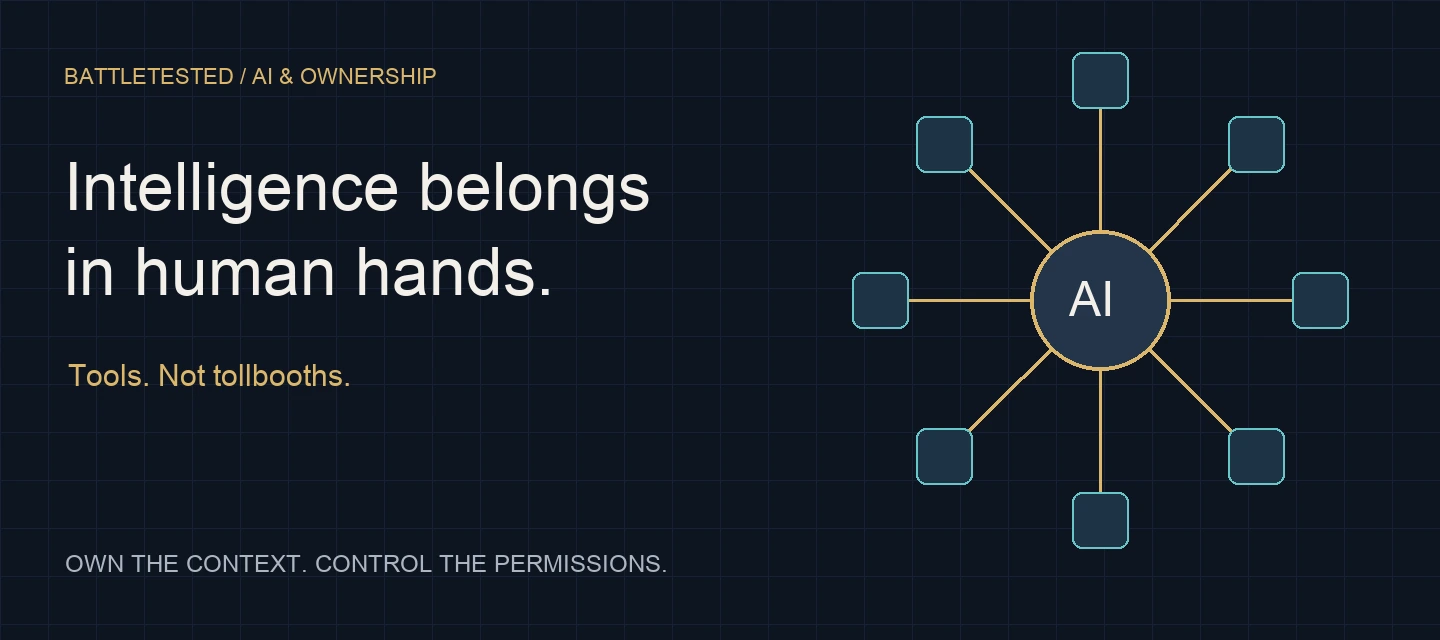
The companies selling intelligence should not own the debate
There is something worth questioning about a company telling you its product will change the world—and then telling you the world cannot be trusted with it.
My concern is not that AI companies discuss risk. They should. My concern is what happens when fear becomes an argument for permanent dependence: use our models, through our infrastructure, under our rules, because giving you meaningful control would supposedly be irresponsible.
That is a convenient conclusion for a company selling access to intelligence. It deserves scrutiny, not automatic acceptance.
This is an argument about incentives, not proof of a secret agreement. AI risks are real, and concern about them comes from researchers, workers, governments, and communities—not just vendors. But the commercial interests of the companies shaping the conversation belong in that conversation too.
Safety should not become a moat
A safeguard and a barrier to entry can look remarkably similar on paper. Both may involve licenses, reporting requirements, and expensive reviews. The difference is whether the burden actually reduces a defined risk—or simply makes participation impossible for everyone except the largest firms.
Ask who can afford compliance. Ask whether independent researchers and smaller developers have a workable path. Ask whether a rule addresses a dangerous capability or sweeps ordinary business software into the same category.
You do not have to dismiss AI safety to reject the idea that a few vendors should become the permanent gatekeepers of useful intelligence. Genuine safety needs scrutiny and accountability. So does concentrated power.
Your business probably does not need a frontier model for every job
An invoice is not an unsolved problem in theoretical physics. Finding a procedure, classifying a support request, or explaining why two inventory numbers disagree usually does not require the most capable general-purpose model available.
For many bounded enterprise workflows, a smaller model with access to the right proprietary knowledge can be enough. Whether it is enough is something you measure on your actual work—not something you infer from a leaderboard or a sales presentation.
There are two different approaches people often bundle together as “training on our data.” Fine-tuning changes model weights using selected examples. Retrieval gives the model relevant documents or database results when it answers. Frequently, retrieval is the better starting point for changing business information: update the source rather than retrain the model every time a policy changes.
The model still needs controls. Retrieved documents can contain bad instructions, access permissions still matter, and a fluent explanation can still be wrong. Use code for calculations, constrained tools for database operations, and evaluations built from real cases.
The useful question is not “Can we buy the smartest model?” It is “What is the smallest, most dependable system that does this job well?”
Local is an option—not a religion
Running a model locally or inside your own infrastructure can give you greater control over sensitive data, model updates, availability, and how the system connects to your business. It can also create work: hardware, patching, monitoring, backups, and security do not disappear.
Local does not automatically mean cheaper, safer, or better. A poorly managed server can be less secure than a well-run hosted service. Some tasks genuinely benefit from frontier reasoning or capabilities your private deployment does not have.
The sensible architecture is often hybrid. Keep routine, well-understood work close to your data. Send harder tasks to an outside model only when the benefit justifies the cost and the data-sharing policy permits it. Keep the option to change providers.
Ownership is not refusing to use someone else’s technology. It is refusing to make someone else’s technology your only possible future.
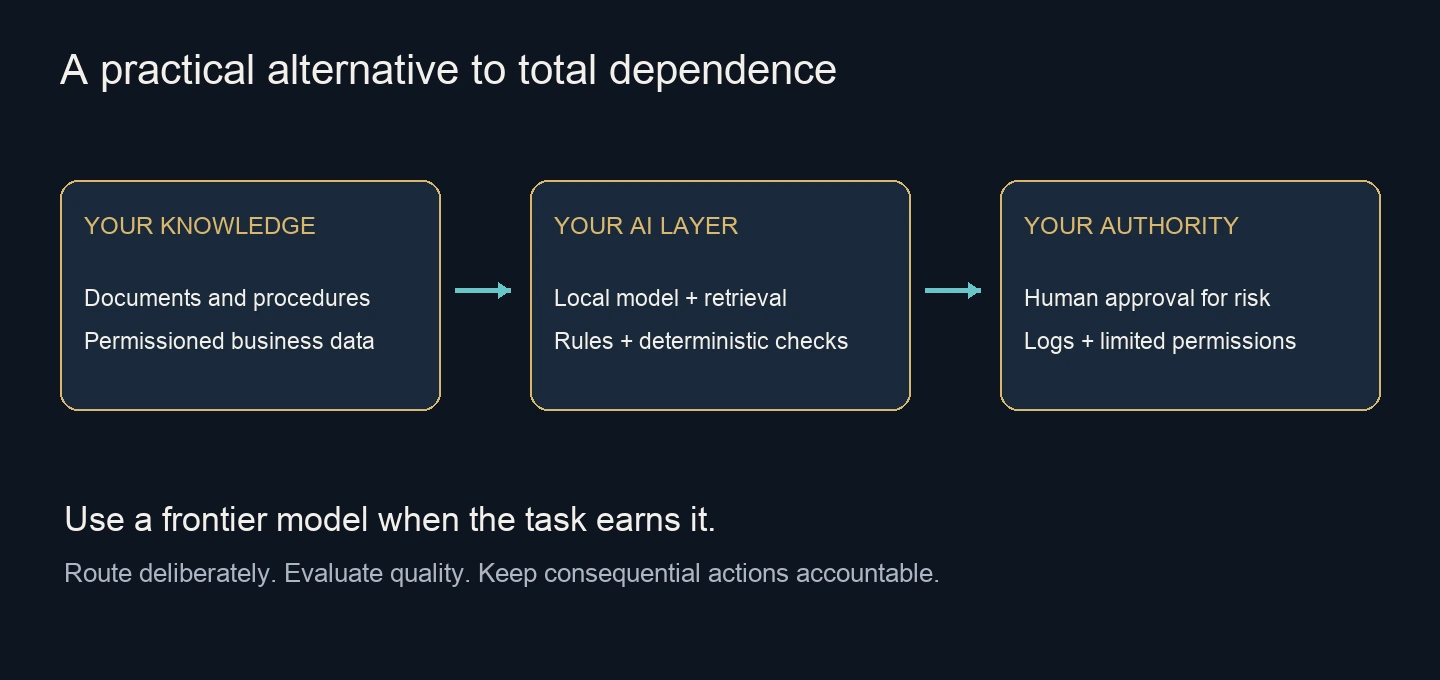
Intelligence is not the same as authority
An AI can be excellent at explaining a financial discrepancy without permission to move money. It can identify an unusual manufacturing pattern without permission to operate machinery. It can help draft a medical research question without being authorized to treat a patient.
Those boundaries are not philosophical abstractions. They are permissions, approval gates, transaction limits, and audit logs.
Broad access to capable models does introduce misuse risks. Human approval alone is not a complete safety system, and some capabilities require stronger restrictions. But the answer should be proportionate to the task and the potential harm—not a blanket assumption that ordinary people cannot be trusted with powerful tools.
Give the tool enough access to be useful. Require evidence for its conclusions. Be much more careful about the power to act than the ability to suggest.
The extraordinary results will come from people we do not know yet
Imagine a small manufacturer giving its best technician a tool that can search every maintenance record and help test competing explanations for a recurring failure. Imagine a teacher creating accessible materials for a student whose needs do not fit the standard curriculum. Imagine a researcher exploring a neglected question because the cost of getting started has fallen.
These are possibilities, not promised outcomes. They illustrate why I am optimistic: useful knowledge is scattered across humanity. So are the problems worth solving.
No central product roadmap can anticipate all of them. The person closest to a problem often knows something a distant platform company does not. Put more capability in that person’s hands and you expand the range of things society can try.
If systems eventually reach what people call superintelligence, the stakes become much higher. That is a hypothetical future, not a description of an ordinary local model today. It would require serious work on reliability, security, and governance. But even then, broad human benefit should remain the goal—not permanent corporate custody of intelligence.
The results could be extraordinary. Some might look miraculous compared with what a small team can do today. Not because the machine replaces human purpose, but because more people can turn their purpose into something real.
Build capability. Not dependence.
The practical starting point is smaller than the rhetoric. Pick a workflow. Identify the authoritative data. Establish who may see it. Test a model against real examples. Connect narrow tools. Measure errors. Expand permissions only when the evidence supports it.
That is how AI becomes an instrument people can use rather than a promise they keep paying for.
I want a future in which a small business can own its operational intelligence, a researcher can investigate an unfashionable question, and a capable person does not need a platform’s blessing to build something useful.
Take the risks seriously. Question the gatekeepers. Put the tools in human hands.
Start with your business—not a model subscription
Want to find out which workflows belong on local models and which actually need a frontier service? Start a conversation with BattleTested. Bring a real process, the systems behind it, and the problems you want to stop repeating.
Related: Local models vs. cloud APIs · Layered model architecture · Trust architecture.