The Problem Everyone Gets Wrong
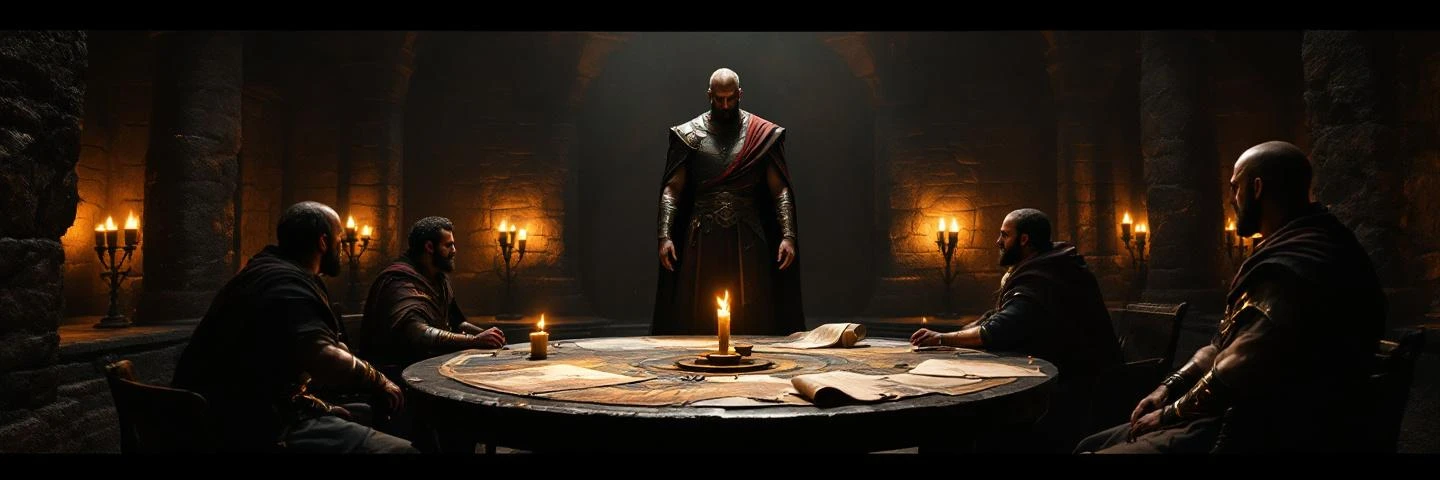
In 1982, Leslie Lamport published a paper about generals surrounding a city. The premise: multiple commanders need to agree on a battle plan, but some of them might be traitors. How do you reach consensus when you can't trust every node in the network?
Computer scientists have spent forty years building solutions — consensus algorithms, Byzantine fault tolerance, blockchain (literally built on this problem). All of them solve the same thing: how do distributed nodes agree on truth when some nodes lie?
Now apply that to AI agents.
You deploy fifteen agents across your business — finance, sales, marketing, operations, security. Each one is making decisions, processing data, generating outputs. Agent A says revenue is up. Agent B says it's flat. Agent C hasn't reported in three hours. Which one do you trust?
This is the Byzantine Generals Problem for the AI era. And right now, the industry is solving it the exact wrong way.
“The answer to 'how do fifty AI agents reach consensus' is: they don't. You do.”
The Wrong Solution: Agent Democracy
The industry trend right now is multi-agent mesh networks. Agents talking to agents. Voting protocols. Consensus layers. Swarm intelligence. It sounds sophisticated. It makes great conference talks. And it creates a system so complex that when something goes wrong — and it will — nobody knows which agent poisoned the well.
Here's the problem with agent-to-agent communication:
- Hallucination propagation. One agent hallucinates a number. Three agents downstream use it. By the time it surfaces, the error has compounded through six decisions.
- Accountability collapse. When Agent A tells Agent B to tell Agent C to execute — who's responsible for the outcome? The answer is always “unclear,” which in business means “nobody.”
- Complexity theater. Every agent-to-agent connection is a potential failure point. A 15-agent mesh has 105 possible connections. Good luck debugging that at 2 AM when your financial reports are wrong.
- The trust problem is unsolvable at the model level. You cannot mathematically guarantee that an LLM will never produce a faulty output. You can reduce the probability. You cannot eliminate it. Any architecture that assumes trustworthy agents is built on sand.
The Right Solution: One Commander, One Consensus
Hub and spoke. Not because it's elegant. Because it's correct.
One orchestrator agent sits at the center. Every specialist agent reports to it — never to each other. The orchestrator synthesizes, validates, and escalates to the one node in the network you can trust: the human.
This eliminates Byzantine failure by design:
- No agent-to-agent trust required. Agents don't need to agree with each other. They each report independently to the hub.
- Single point of validation. The orchestrator cross-references outputs. If the finance agent says revenue is $400K and the sales agent says it's $380K, the orchestrator catches it before it reaches a dashboard.
- Human consensus mechanism. For anything that matters — outbound emails, financial reports, strategic decisions — the human is the final authority. Not a voting quorum of language models.
- Full audit trail. Every instruction flows through one node. Every output flows back through the same node. You can reconstruct exactly what happened, when, and why.
“But what about scale?” I hear this objection constantly. If everything goes through one orchestrator, doesn't that create a bottleneck?
It does. And the answer to that isn't “add more connections.” It's something far more interesting.
The Insight Nobody Talks About: Software Graduation
Here is the thing that changes the entire calculus of AI workforce design, and I have never seen anyone else articulate it:
When an AI agent builds a dashboard, that dashboard is no longer AI. It's software.
Read that again.
“The agent's job is to build the thing. Once built, it graduates from AI into infrastructure. The agent moves on. The software stays.”
Think about what actually happens when you deploy an AI agent workforce:
- An agent builds a cron job that pulls precious metals spot prices every four hours and writes them to a database. That cron job is now a scheduled task. Not AI. Just software. Running reliably the way cron jobs have run for forty years.
- An agent designs an email template with deep links to your ERP, triggered by carrier delivery webhooks. That's now a webhook-driven email system. Not AI. Just event-driven architecture.
- An agent builds a dashboard showing rep performance against KPIs with real-time data from your CRM. That's now a Next.js app with a database connection. Not AI. Just a dashboard.
- An agent writes a Python script that reconciles eBay fees against net payouts using FIFO costing. That's now an accounting pipeline. Not AI. Just math.
Every one of these started as an AI project. Every one of them graduated into traditional software. The AI was the builder, not the product.
The Governance Framework
With hub-and-spoke plus graduation, governance becomes tractable. Here are the five rules:
1. No Lateral Communication
Agents never talk to each other. Period. If the marketing agent needs data from the finance agent, the request goes through the orchestrator. This is not a limitation — it is the entire point. Every agent-to-agent message you prevent is a potential hallucination cascade you eliminate.
2. Human-in-the-Loop for Outbound Actions
Any action that leaves the system — emails, API calls to external services, financial transactions, public posts — requires human approval. The agents propose. The human disposes. This is non-negotiable.
3. Graduated Software Is Deterministic
Once an agent's output stabilizes into software, that software runs deterministically. A cron job that calculates yesterday's margin does not hallucinate. A webhook that fires on delivery status does not have opinions. An ETL script that transforms data does not get creative. The AI built it. The software runs it. These are different things.
4. The Orchestrator Is Stateful, Agents Are Stateless
Only the orchestrator maintains persistent memory across sessions. Specialist agents wake up, do their job, and shut down. They don't accumulate context that could drift. They don't develop “habits.” They execute against a defined scope and return results.
5. Audit Everything, Trust Nothing
Every agent action is logged with timestamp, input, output, and the human decision that authorized it. Not because you expect failure — because when failure happens (and it will), you need to reconstruct the chain in minutes, not days.
Why This Matters for Your Business
If you are evaluating multi-agent AI — or if someone is selling you a “swarm intelligence” platform — ask them three questions:
- When Agent A hallucinates, how many other agents are affected? In a mesh, the answer is “potentially all of them.” In hub-and-spoke, the answer is “zero — the orchestrator catches it.”
- What happens to your costs as the system matures? In a mesh, you pay for N agents running perpetually. In a graduation model, your AI costs decrease over time as work products become traditional software with zero marginal inference cost.
- Can you show me the audit trail for this decision? If the answer involves tracing messages across a mesh of autonomous agents, you have a compliance nightmare. If every action routes through one hub with human sign-off, you have a paper trail a regulator could follow.
The Uncomfortable Truth
The reason nobody talks about hub-and-spoke is that it's boring. It doesn't make a good demo. “Look, our agents coordinate through a central orchestrator with human approval” will never get you a standing ovation at a tech conference. But it will get you a system that works at 3 AM on a Sunday when nobody's watching.
The reason nobody talks about software graduation is that it kills the recurring revenue narrative. If you are an AI platform vendor, the last thing you want clients to realize is that the work your agents do should eventually stop requiring agents. That a well-built AI workforce makes itself progressively less necessary as it converts intelligence into infrastructure.
But if you are the operator — the person running the business, signing the checks, accountable for outcomes — this is the best possible architecture. Your AI costs go down. Your reliability goes up. Your graduated systems run deterministically on battle-tested infrastructure. And the agents that remain are focused on the genuinely novel problems that still require intelligence.
“The best AI workforce is one that builds itself out of a job. What remains is lean, governed, and ruthlessly focused on what only intelligence can do.”
Bottom Line
The Byzantine Generals Problem assumes you need distributed consensus. You don't. You need a commander, an orchestrator, and a graduation path that converts AI work products into deterministic software.
Hub and spoke. Human consensus. Software graduation.
It will never be the sexiest talk at the conference. But it will be the system still running — quietly, reliably, profitably — long after the swarm intelligence demos have crashed and burned.