
The Headline That Broke the Internet
In early 2026, Jack Dorsey announced that Cash App's workforce would shrink from roughly 10,000 to 6,000 — and he pointed directly at AI coding agents as the reason. The headlines wrote themselves. “AI Replaces 4,000 Developers.” “The End of Software Engineering.” LinkedIn erupted. Twitter was insufferable.
There was just one problem with the narrative.
Developer jobs were up 10% year-over-year. Not down. Up.
Both things are true. And if that seems like a contradiction, you are thinking about this wrong. The Industrial Revolution already showed us exactly how this plays out — and the answer is not what either side wants to hear.
The Calorie Ceiling
Before the Industrial Revolution, roughly 80% of the workforce was employed in food production. Farming was the economy. Then machines arrived — the cotton gin, the mechanical reaper, the steam-powered thresher — and the labor required to produce food collapsed. Today, about 2% of the American workforce feeds the entire nation.
We produce astronomically more food than we did in 1800. But here is the critical insight that most people miss when they apply this analogy to software:
There is a ceiling on calorie consumption.
A wealthy nation cannot eat a thousand times more food than a poor one. A billionaire does not consume 10,000 times more calories than a subsistence farmer. The human body has a hard limit. Once mechanized agriculture met that limit, the percentage of people working in food production could only go down.
The surplus labor did not disappear. It moved. Into manufacturing. Into services. Into entirely new industries that could not have existed when 80% of human effort was dedicated to not starving. The economic pie grew — it did not just redistribute.
Software Has No Calorie Ceiling
This is the part that breaks the analogy — in favor of software developers, not against them.
Food consumption has a biological limit. Software consumption does not.
Think about what a mid-market company runs today versus 2015. A decade ago, most businesses had maybe a website, an ERP, and a CRM — if they were sophisticated. Today they need analytics dashboards, automated marketing workflows, customer portals, internal tools, API integrations, mobile apps, data pipelines, AI agent systems, compliance platforms, and a dozen micro-services stitching it all together.
And that is just what they can afford to build today.
For every piece of software a company actually builds, there are ten they should build but cannot justify the cost. Custom inventory management. Automated reconciliation. Real-time shipping notifications that trigger sales calls. Automated call logging from VoIP to CRM. Internal knowledge bases that actually work. The list is functionally infinite.
When you reduce the cost of producing something with infinite demand, you do not get less production. You get an explosion.
What Dorsey Actually Proved
Jack Dorsey cutting 4,000 positions is real. Those people really lost their jobs. That matters and it should not be dismissed. But here is what that number actually tells us:
Cash App can now build and maintain the same product with fewer people. That is a productivity gain. The question everyone should be asking is not “where did the 4,000 jobs go?” — it is “what can now be built that could not be justified before?”
When mechanical agriculture freed 78% of the workforce from farming, the answer was not “78% unemployment forever.” The answer was the modern economy — industries that were literally unimaginable when most humans spent their days behind a plow.
When AI coding agents make a developer 3x more productive, the answer is not that we need one-third as many developers. The answer is that companies will build three times as much software. And then ten times. And then a hundred.
The SMB Explosion Nobody Is Talking About
The biggest impact of AI coding agents is not at companies like Block. Cash App was already building sophisticated software with expensive engineering teams. They were already in the game.
The real story is the companies that were never in the game at all.
I work with small and mid-market businesses every day. Companies doing $1M to $50M in revenue. Companies that have been told for years that custom software is not for them — that they should buy off-the-shelf SaaS, make do, patch it together with spreadsheets and prayers.
These businesses have massive unmet software needs. They have processes that should be automated. They have data that should be connected. They have dashboards they need but cannot afford to build. They have AI use cases that would transform their operations — if someone could build them at a price point that makes sense.
AI coding agents change that math completely.
A system that used to take a team of three developers six months can now be built by one developer in six weeks. The cost drops by 80-90%. Suddenly, the automated reconciliation system that was “nice to have” becomes a no-brainer. The custom CRM integration that was “too expensive” becomes table stakes.
The Demand Curve Is Vertical
Here is the math that matters:
- Large enterprises (Fortune 500) — already building lots of software, will build it faster and cheaper. Some internal headcount reductions. Net job impact: roughly neutral.
- Mid-market companies ($10M-$500M) — sitting on enormous backlogs of “we should build that someday” projects. AI agents make them economically viable. Net job impact: strongly positive.
- Small businesses ($1M-$10M) — never had custom software at all. Entirely new market opens up. Net job impact: explosive growth.
- Micro-businesses and solopreneurs — previously could not afford any development. Now they can. Entirely new demand category.
The enterprise headcount cuts make headlines. The SMB explosion happens quietly, one small project at a time, across millions of businesses. A full AI agent team that would have cost $500K/year in developer salaries can now be deployed for a fraction of that — and suddenly companies that never dreamed of AI agents are running them.
The headline says “4,000 jobs cut.” The reality is 40,000 new projects that were not economically viable last year.
History Rhymes, Loudly
Every major productivity leap follows the same pattern:
- The existing market gets disrupted. Incumbents produce the same output with fewer people. Jobs are lost. This is the part that makes headlines.
- Prices drop. The product or service becomes accessible to people who could not afford it before.
- Demand explodes. New markets emerge. New use cases are invented. New industries appear.
- Total employment increases. Not in the same jobs — in new ones. Different ones. Often better ones.
The printing press did not destroy the scribe profession and stop there. It created publishing, journalism, mass education, and the Reformation. The automobile did not just kill farriers and stable hands — it created suburbs, supply chains, road construction, fast food, and everything you see from a highway.
AI coding agents will not just make existing development faster. They will create entirely new categories of software that we cannot even name yet. Because for the first time in history, a 10-person company can build tools that were previously reserved for companies with 100-person engineering teams.
The Data Just Proved It
On March 6, 2026 — the same day I wrote this post — Anthropic economists Maxim Massenkoff and Peter McCrory published a study introducing a new metric called “Observed Exposure.” It compares what LLMs can theoretically do in each occupation against what people are actually using them for at work.
The results are staggering:
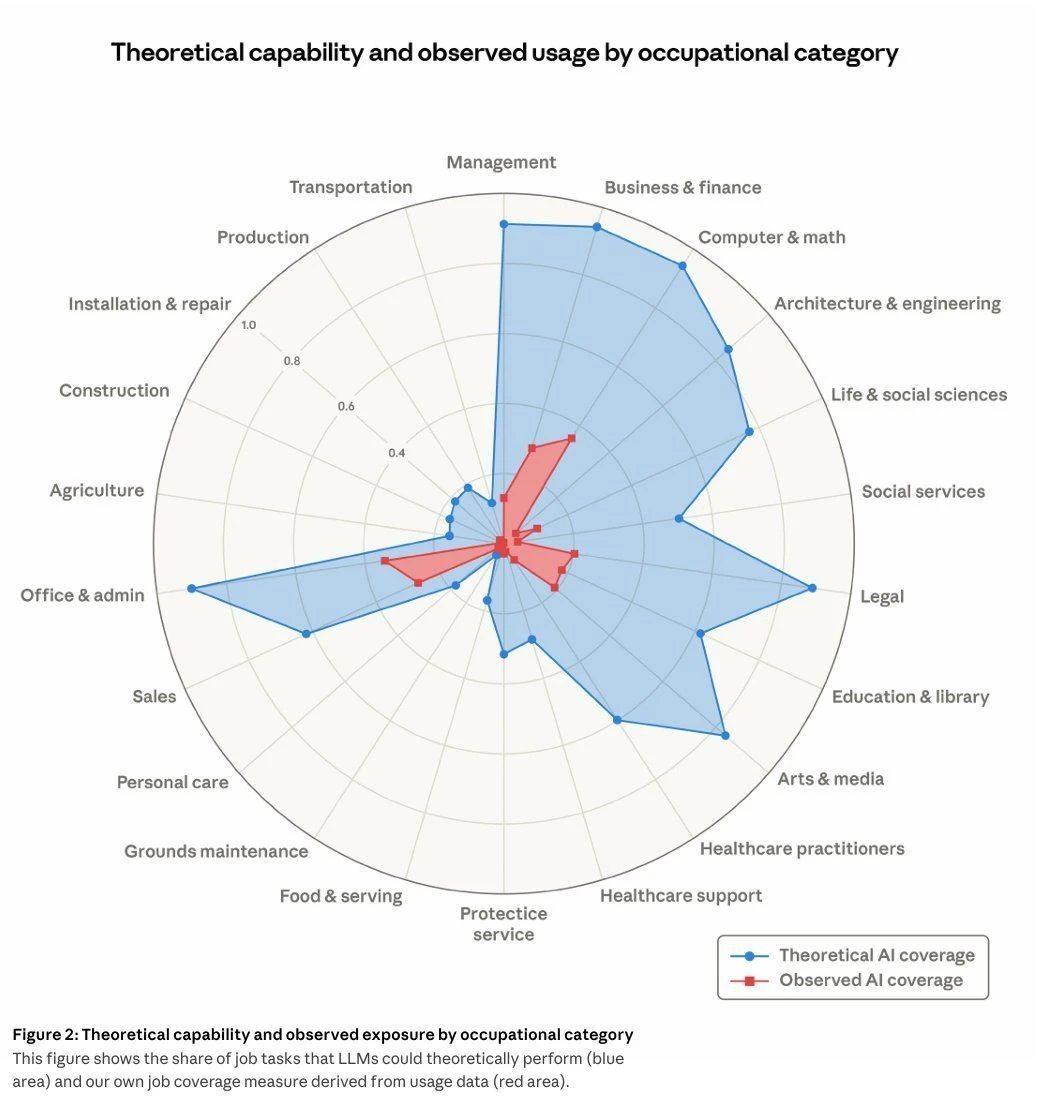
Source: Massenkoff & McCrory, Anthropic Economic Index (March 2026)
Look at the gap. In Computer & Math — the field with the highest actual AI adoption — Claude covers just 33% of all tasks it is theoretically capable of handling. In Legal, Education, Healthcare, and Arts & Media, observed usage barely registers against theoretical capability.
This is not a chart of an industry being disrupted. This is a chart of an industry that has not started being disrupted yet. The window is open right now, and the opportunity is not going to be evenly distributed.
First Movers Win This One
With most technologies, early adopters get burned. Anyone who has ever shopped for a computer knows the game: wait six months, get something faster, better, and cheaper. The early bird gets the worst product.
AI does not work that way.
The models will improve — no question. But the companies that implement AI today are not buying a static product that depreciates. They are building organizational muscle. They are learning how to prompt, how to integrate, how to build workflows around AI. That institutional knowledge compounds. The company that starts today will be miles ahead of the company that starts in 2028, even if the 2028 models are technically superior.
The benefits of this technology will not be evenly distributed. Companies that implement now will capture a disproportionate share of the reward. And the gap between movers and waiters will only widen as the models get better — because the movers already know how to use them.
The Roles That Were Never Filled
Here is the part that keeps me up at night — in a good way.
Most SMBs cannot afford a dedicated cybersecurity person. They cannot afford a full-time copywriter. They cannot justify a PPC specialist or a data analyst or a compliance officer. These are not luxury hires — they are critical functions that simply do not exist in companies under a certain revenue threshold.
AI agents fill those gaps. Not as a compromise. Not as a “good enough.” As a genuine capability that did not exist before at this price point. A layered AI architecture can give a 15-person company the analytical firepower of an enterprise — at a fraction of the cost.
This is not about replacing the cybersecurity person. It is about giving one to the company that never had one. The chart above shows the gap between theoretical and observed. That gap is your opportunity.
What This Means for You
If you are a developer: learn to work with AI agents. The developers who get replaced are the ones who refuse to use the tools, not the ones who embrace them. Your value shifts from writing code to designing systems, understanding business logic, and orchestrating AI agents to build what the business actually needs.
If you are a business owner: now is the time. The software you have been told you cannot afford? You can probably afford it now. The multi-channel integration you have been patching with spreadsheets? Build the real thing. The AI agents that seemed like science fiction two years ago? They are production-ready and they are cheaper than your current manual processes.
If you are a policy maker: stop looking at headline job cuts and panicking. Start looking at the demand side. The question is not “how many developers will AI replace?” — it is “how much software does the world actually need?”
The answer, as far as anyone can tell, is effectively unlimited.
The Punchline
Jack Dorsey is not wrong. AI coding agents really are powerful enough to do the work of thousands of engineers. Block really can run Cash App with fewer people.
The mistake is assuming that the total amount of software the world needs is fixed — that if you can build it faster, you need fewer builders. That logic works for food. It does not work for software.
We are not approaching a ceiling. We are removing one.
The Industrial Revolution did not eliminate work. It eliminated scarcity in one domain and unlocked entirely new ones. AI coding agents are doing the same thing — not for food, but for software. And unlike calories, there is no biological limit on how much software a business can consume.
The developers who lost their jobs at Cash App will find new ones. Not because of wishful thinking, but because millions of businesses just realized they can finally afford to build what they have always needed.
The pie is not shrinking. It is exploding. And the companies that move first — the SMBs that start building now — will eat the ones that wait.