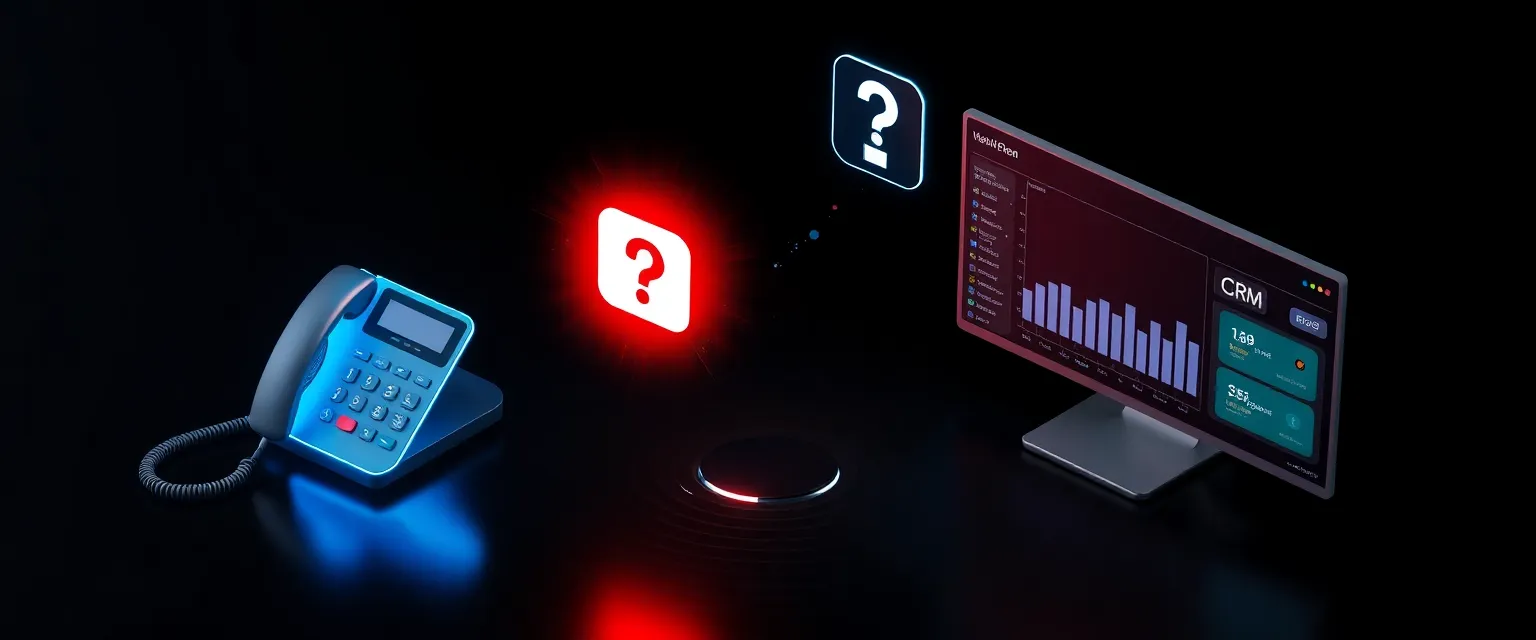
The Stranger on the Phone
The phone rings. Your rep picks up. “Thanks for calling, how can I help you?”
On the other end is a customer who has spent $47,000 with your company over four years. He called last month. He opened your last three marketing emails. His last order shipped two weeks ago — he is probably calling about it. He is one of your top 50 customers by lifetime value.
Your rep knows none of this.
To the rep, this is a stranger. Same greeting, same script, same hold music as the person who found your number on Google five minutes ago and has never spent a dollar. Your best customer and your coldest lead get identical treatment — because the phone system and the CRM have never exchanged a single byte of data.
You are spending five figures a year on a CRM and five figures a year on a phone system. They sit on the same network, in the same office, serving the same customers. They have never met.
What the Rep Should See
Here is what connected looks like. The phone rings. Before the rep picks up, a panel appears:
- David M. — Lifetime value: $47,200
- Last order: 14 days ago (SO-4821, $3,200, delivered Tuesday)
- Assigned rep: Abbey C.
- Engagement: Opened spring campaign 3x, clicked 2x
- Phone type: 📱 Mobile (textable)
- Notes: Prefers gold Eagles, birthday in June, referred 2 customers
The rep picks up: “David, good to hear from you. Everything arrive okay from last week?”
David is surprised. Delighted. He feels known. He was calling to ask about a new product, and the rep — already armed with his preferences and history — recommends the exact right piece. Sale closed. David mentions his brother-in-law who collects. Referral captured.
Same customer. Same phone call. Radically different outcome. The only difference: a webhook, a database lookup, and a screen pop.
The Mobile Number Problem Nobody Talks About
Here is a question most CRM vendors will not ask you: do you know which of your customer phone numbers are mobile?
Your CRM has a phone field. Maybe a mobile phone field too. But in practice, numbers get entered wherever — a mobile number in the “work phone” field, a landline in the “mobile” field, a VoIP number that looks like a landline but accepts texts. The data is unreliable because nobody verified it at the point of entry.
This matters because texting is the highest-engagement communication channel in B2C and many B2B contexts. Your reps want to text customers. Customers want to be texted. But:
- Texting a landline fails silently — the customer never sees it, the rep thinks they are being ignored
- Calling a mobile when a text would suffice annoys the customer and wastes the rep's time
- Not knowing which numbers accept texts means reps default to email — the lowest-engagement channel
The fix: Run a carrier lookup on every phone number in your CRM. Services like Twilio Lookup or NumVerify will tell you: mobile, landline, or VoIP. Cost: fractions of a penny per lookup. For a 10,000-contact database, you are looking at $30-50 total.
Once enriched, your reps see a 📱 icon on textable numbers. It is a small thing that changes behavior overnight. Reps who were defaulting to email start texting. Response rates go up. Engagement windows that used to close stay open.
The Engagement Score Your Reps Cannot See
Your email marketing platform — Klaviyo, Mailchimp, HubSpot, whatever — knows exactly how engaged each customer is. Opens, clicks, purchases, recency, frequency. Some platforms compute an actual engagement score. Others give you the raw events to build one.
None of this reaches the rep.
The marketing team can see that Jennifer opened three emails this week, clicked on the gold Eagle promotion twice, and has not purchased in 90 days. This is a customer waving her hand saying “I am interested.” But the rep assigned to Jennifer has no idea. The CRM shows her last order date and her phone number. That is it.
When you pipe the engagement score into the CRM — even as a simple Hot/Warm/Cold indicator on the contact record — reps can prioritize by intent instead of working alphabetically or by gut feel. The rep calls Jennifer today, not next week. Jennifer buys. The marketing campaign actually drove a sale, and you can prove it.
Marketing generates interest. Sales converts interest. When the two systems are disconnected, interest evaporates in the gap between them.
What Happens When a Call Is Missed
In a disconnected stack, a missed call is a non-event. The phone rang. Nobody picked up. Maybe a voicemail was left. Maybe not. It vanishes into the ether.
In a connected stack, a missed call triggers a cascade:
- Webhook fires — within 2 seconds of the call ending, the VoIP system sends a POST to your endpoint with caller number, time, and disposition.
- Contact lookup — system searches CRM by phone number (normalized to E.164). Finds David M., $47K LTV, assigned to Abbey.
- Auto-SMS — David receives a text within 8 seconds: “Sorry we missed your call. Someone will be right with you.”
- Rep notification — Abbey gets a push notification: “Missed call from David M. — $47K LTV — call back now.”
- CRM logging — Missed call recorded on David's contact timeline with timestamp, duration (0), and disposition (no answer).
- Escalation timer — If Abbey does not call back within 15 minutes, a high-priority task appears in her queue. If 30 minutes pass, her manager gets notified.
One company recovered a $5,000 sale in the second week after deploying this exact pipeline. The customer had called, gotten voicemail, and was about to call a competitor. The callback came within 3 minutes. Sale closed. Engagement paid for itself.
The Delivery Moment Nobody Captures
Your customer ordered. You shipped. The carrier marked it delivered. What happens next?
In most companies: nothing. The customer gets a tracking email from UPS or FedEx. That is the end of the interaction until the customer decides to come back — or does not.
In a connected system, the carrier's delivery webhook triggers a notification to the selling rep: “David M.'s order delivered today.” The rep calls: “Just wanted to make sure everything arrived safely.”
This is the dopamine moment. The customer is holding their purchase, experiencing peak positive emotion toward your brand. A phone call at exactly this moment — from the person who sold them the product — creates a loyalty bond that no email sequence can match.
The rep did not need to check tracking manually. They did not need to remember when orders shipped. The system told them. The plumbing did the work. The rep just picked up the phone.
The Architecture
This is not complicated infrastructure. It is a series of connections between systems that already exist:
VoIP Provider                 CRM
─────────────                ─────
  Call events  ──webhook──→  Contact timeline
  Missed calls ──webhook──→  Task + notification
  Call records ──────────→  Analytics pipeline

Email Platform               CRM
──────────────              ─────
  Opens/clicks ──sync────→  Engagement score
  Campaigns    ──────────→  Attribution data

Carrier API                  CRM
───────────                 ─────
  Delivery     ──webhook──→  Rep notification

Phone Lookup                 CRM
────────────                ─────
  Carrier type ──batch───→  Mobile/landline flag
Each connection is a webhook or a scheduled sync. Each takes a day or less to build. Each starts delivering value immediately. There is no “Phase 2” — every connection works independently from day one.
The Objection: “Our CRM Can Do This”
Technically, yes. HubSpot has a calling feature. Salesforce has CTI. Most modern CRMs offer phone integration.
But there is a difference between “offers” and “connected.” In practice:
- The CRM's built-in calling costs $50-100/user/month on top of your existing VoIP
- It does not integrate with your existing phone system — it replaces it (and your team hates it)
- It captures CRM-initiated calls only — not inbound calls, not missed calls, not voicemails
- It does not enrich contacts with carrier data, engagement scores, or order history from external systems
The vendor solution solves 30% of the problem and costs more than solving 100% yourself. A webhook integration with your existing VoIP costs almost nothing to build and captures everything — inbound, outbound, missed, voicemail, after-hours.
Start Here
You do not need to build all of this at once. Here is the sequence that generates value fastest:
Day 1: Ask your VoIP provider if they support webhooks. Most modern platforms do — you just never asked. Get the documentation.
Day 2: Build a simple endpoint that receives call events and logs them to a database. Do not connect the CRM yet — just capture the raw data. You will be shocked at what you learn from a week of call event data.
Day 3-4: Add CRM contact matching. Phone number → contact lookup → log the call on their timeline. Now every call appears on the contact record automatically.
Day 5: Add missed call alerts. SMS to the caller, notification to the rep. This is where the money starts flowing back.
Week 2: Run the carrier lookup batch on your entire contact database. Flag every mobile number. Watch your reps start texting.
Week 3: Pipe email engagement scores into the CRM. Now reps can see who is hot, who is cold, and who just opened three emails but has not ordered in 90 days.
Each step is independent. Each delivers value on its own. And each one builds toward the connected system where your reps have full context on every customer interaction — without ever leaving the CRM.
The Number to Remember
Carrier lookup on 10,000 contacts: $35.
Webhook integration with your VoIP: $0/month (serverless function, negligible compute).
One recovered missed call from a $5,000 customer: pays for everything.
The phone and the CRM have sat three feet apart for years. It is time they met.